Sunday, June 13, 2010

Dinner Tonight: Zucchini Fritters with Romanesco Salsa, Peperoni in Padella col Pomodoro, and Ravioli con Ricotta e Spinaci col salvia


We had a lazy Sunday, and I was meaning to go grocery shopping today, we were meaning to go to the vineyard, and we never got to either place. So, dinner was the result of what we had on hand.
The zucchini fritters with the Romanesco sauce is a recipe that I got from my cousin in Toronto who took a cooking class. They are made by grating zuchini; I used 2 very large zuchini that Giacomino gave me yesterday, grating an onion, chopping up 1 clove of garlic, parmesan cheese, and adding to that 2 eggs, and flour. I squeezed the extra liquid out of them, formed little patties, and fried them in olive oil, because I didn't have any grapeseed oil on hand.

The salsa calls for tomatoes, a handful of almonds, parsley, de-pitted green olives, roasted red peppers n brine, all mushed up in the blender, oh...and a red hot dried pepper. I don't use quantities when I cook...you'll have to guess. Here's what it looked like on the plate. They were crunchy on the outside, and sweet on the inside with the sauce adding zest and flavor, and spice.

I also needed to finish off some green peppers that I had in the fridge, so I made a typical neapolitan dish: peperoni in padella col pomodoro (green peppers and tomatoes fried in olive oil and garlic). I vary the recipe, and some neapolitans may tell me that I've made it all wrong, but to my palate, it tastes the same. I cut up the green peppers and tomatoes, and fry them both together in olive oil and garlic. I didn't have a lot of tomatoes left, so I didn't get a lot of juice from it. It's best served on fresh pane a legna, a dense, heavy bread, sold by the 1/2 or kilo, cooked in a wood-fired oven.

The last dish was Ravioli filled with Spinach and Ricotta, with olive oil a little bit of butter, sage, topped with tomatoes and fresh Italian parsley. If you would really like any of these recipes please let me know, and I will do my best to come up with quantities. The wine? That was left over too--last night's Falanghina/Garganega. It all tasted so good.

Trying to Make Sense of New EU Rules Governing Wine and a couple of questions.

The EU has recently legislated new communal regulations regarding food and drink, and wines have not escaped the makeover. There was a lot of negativity in the industry, as you can well imagine, when the reforms were first proposed as every country scrambled to decode the regulations to figure out what the impact would be for them. Thankfully, the reforms also insure that traditional “best-practices” that currently offer such diversity in the Italian wine landscape for example, are preserved throughout the re-structuring.
I have read as many articles as I could find on the subject, which I have referenced below, and have summarized, and greatly simplified the amendments, which apply to the vineyard owner, the winemaker and the consumer.

The main reasons for the reform were to effectively deal with overproduction, to harmonize vineyard practices and winemaking rules, and to create more transparent labeling practices to make choices clearer for the consumer throughout all EU member states.
While Europe is still the biggest producer and exporter of wines, New World wines seem to be gaining greater market shares and this fact has led European winemakers and economists to squirm and look for ways to maintain and increase their foothold.

The first area that caught the eye of the Common Market Organization for Wine (wine CMO) was the wasteful surplus of wine due to overproduction. They have set out a plan to eliminate this surplus and equilibrate supply with demand. Every year Europe is left with large quantities of wine for which there is no market and they must then deal with costly decisions either to store or distill the surplus. Hence, they decided that a good way to discourage this practice is to eliminate distillation or storing subsidies and to encourage producers only to make wine in the amount that they can sell.

Overproduction is also directly related to over planting to which the following rules have been established with regard to the conversion and re-structuring of vineyards:
-grubbing up of unlawful plantings (literally pulling up vines) which according to the Official Journal of the EU “constitutes a source of unfair competitions and exacerbates the problems of the wine sector”. As well, there is a 3-year voluntary grubbing up scheme for producers who wish to turn their vineyards into other uses.
They have incorporated stricter rules and monitoring with respect to awarding planting rights or replanting rights
-maximum yields per hectare preserving the quality of the grape over quantity
-the grapes planted must be of the vitis vinifera species, the species native to Europe

The most salient regulation for winemakers seems to focus on the prohibition and/or limitation of the practice of chaptilisation (the addition of sucrose to a low-alcohol wine or use of concentrated musts in order to increase the natural alcohol strength of the wine) except in certain areas where achieving ripeness in the grapes (and thus minimum sugar content) is difficult due to climatic factors. In these areas, chaptilisation will have maximal limits: 2% for Spain, Slovakia, Slovenia, Hungary, Italy, Portugal, Greece, Cyprus, Malta, and 1% for certain parts of France.
Why would this practice have come under the microscope? Well, some consider the artificial addition of sugar gives the wines a certain “blousy” unnatural effect (MacNeil, Karen: The Wine Bible). The regulations aim at improving the quality of wines.

Everyday consumers are often perplexed by the complicated and diverse labeling systems that don’t give the consumer a lot of information about what they are buying. Not only do rules governing quality vary from country to country, but some EU countries (France, Italy and Spain), label their quality wines for the terroir from which they come. In other words, the place of Origin and associated traditions and grapes varietals particular to that area, represent quality in some countries, while others govern their labeling purely on quality, unrelated to terroir, such as Germany.

Labeling rules have been simplified to allow more transparency for the consumer and must conform to the new labeling hierarchy as illustrated below. Each country will have the same categories.
The IGP wines (Indicazione Geografica Protetta, or PGI, Protected Geographical Indication) were formerly the IGT category of wines in Italy.
The DOP wines (Denominazione d’origine Protetta, or PDO, Protected Designation of Origin), which in Italy are the former DOCG and DOC wines, consolidated into one category.Before this reform, these terms only applied to food products such as cheese, some fruits and vegetables and olive oils. Now these terms apply to wines. IGP wines may also include the former table wines that had a Geographical indication. Table wines without the Geographical Origin would be delegated to the category of “Wines or wines without a geographical Indication”. Wines in this category will now be allowed to mention the grape variety and the vintage. The accuracy of this information will be monitored by authorities, and the list of grape varieties will be limited.
The new rules were legally adopted in March 2008, came into effect in Aug, 2008, but producers have until December 2010 to comply with the new labeling rules.

The question that comes to mind in all of this, and I admit that my research has been cursory, is how will the consolidated category of DOP wines make the distinction between the current 49 Italian DOCG's which are, as I understand, of superieor quality, to the more 300 DOC's?
And I have one more question related to this...how will future superior Italian wines distinguish themselves? Perhaps, I've got to get away from the old categories. Perhaps, this time it will be left to the consumer to decide.
I welcome any comments, answers or clarificatons.

You may read the reforms in English at the following site
http://www.apeda.com/apedawebsite/Announcements/LexUriServ_479.pdf - 61 pages

You may read the more concise and comprehensive EU Commissioner for Agriculture and Rural Development, Mariann Fischer Boel’s explanation and justification for the reforms at
http://ec.europa.eu/agriculture/capreform/wine/infopack_en.pdf
Both of the above were sources used for this article as well as

http://reignofterroir.com/2009/06/21/the-wines-they-are-a-changin-the-new-eu-regulations/

While the Italian wine pyramid in this article is my own drawing, the original comes from the following Italian site
http://www.edagricole.it/terraevita/archivio/2010/18/TV_10_18_p022-24_OCM%20vino.pdf

http://www.calwinexport.com/files/Europe%20Wine%20Reform%202008.pdf

Friday, June 11, 2010

Getting from Here...To There


Here There

As we tie the last vines we hear our very secretive neighbor call out to us once again. She has been making herself known on our frequent visits, but refuses to show herself. Her call sounds an awful lot like “cu-cu”, begging us to repeat it back to her. This is the first time I think we’ve ever heard a real cuckoo before. I look around, but I can’t see her. I call her a “her” because she doesn’t appear to be doing a lot of work while we are there. Female cuckoos are a clever, lazy, lot and get other birds to make their nests, and even raise their young. They will go as far as eating the other eggs in the hosts’ nest that they choose. They spy on the nests’ occupants closely, and can often mimic their eggs in color and size. The foster parents are none the wiser, and lavish the young cuckoo with all the love and attention that they would offer their own. Where’s the satisfaction in that, I wonder.
But then, as the spring sun heats up, and we can barely work past noon anymore, and whatever unseen, unheard bugs that have found a take -out lunch on my neck bring my frustration level to boiling point, I entertain the thought, for a while, of hiring someone to do this work. I’m in a sea of grapevines, and I know that if I stop now and linger on that thought for too long, I might give into it, so I put one foot in front of the other, and go to the next vine. It becomes apparent to us that we will have to move: either closer to Solopaca, or build something on the property. We should be doing this work in the early morning and late evening, but we live too far away for that right now. No one works in the afternoons here except us; it’s just too hot.
We are beginning to know our vines, and they are beginning to respond in a way that kind of makes us proud. I can’t help making the comparison between parents and children. It is very similar to the pride that I feel towards my own children when they accomplish or do good things. We have put the time into parenting these vines, and they’re responding, just like we had hoped.


We venture into a part of the vineyard that we haven’t been to for a while. We tend to spend a lot more time on the first rows than we do the last. As I am the first on this day to venture into this area, I am also the first to feast my eyes on a wall of overgrown cherry trees. We’ve heard locals refer to our part of the town as “Ceraselle” meaning “little cherries” for the now wild cherry trees that grow up here. I look up and there is a wall of green with bursts of bright red cherries. I’m delighted and I call everyone over to see it . Our son Adam acts rather blasé but it is he who took these photos:


Ron, my husband, thinks this should be the business name for the vineyard. The cherries are my pat on the back today…they seem to have recognized our efforts all these days, and reach out with their beauty to our tired spirits, and make us feel like it is worthwhile.
Something the cuckoo bird will never know.


Tasting notes tonight are of a local wine from Benevento. This wine, though not from Solopaca is from a town higher up the mountain in Frasso Telesino. It is IGT because of the use of the garganega grape which is not a local grape but more widely used in the Veneto region in Soave and Gambellara.


Azienda Agricola De Fortuna
Falanghina Beneventano IGT
Finile 2009
Grapes: Falanghina and Garganega
ABV 12,5%
The wine is bright, crystal clear and straw yellow in color, and almost transparent but with a slight tinge of green on the rim. It is fairly viscous with fairly quick tears, medium in size.

The town where the grapes are grown, Frasso Telesino, is located at about 374m above sea level, and has greater fluctuations in day and night temperatures than Solopaca where we are located, so I’m expecting to find more exciting aromas in the wine: it is intense with sweet, spring flowers like jasmine, and fruit-filled of pear, citrus, and definitely some flinty mineral tones, some almond. The wine is fairly complex in its aromas and presents an elegant bouquet. This wine has made a very good first impression.
To the taste it is dry, leaves behind a warmth from the alcohol, but is nice and smooth. There is a light and pleasant freshness from the acidity which is well balanced against the smooth feel of the wine. There is a liveliness there, but also a very persistent minerally,
flinty aftertaste which I think comes from the Garganega. What a lovely combination in a wine.
It is of medium structure, well-balanced, fairly intense and persistent. It has good overall harmonious qualities, and an elegant finish. Complimenti Azienda De Fortuna! It's late, and I'm afraid, I opened the wine just to taste, so I haven't paired it with anything. It's length and persistence would have be believe that it could handle a little competition from the food: perhaps stronger tasting fish dishes, medium-aged cheeses.

Thursday, May 27, 2010

Filiberto

This is the 4th time today that I see what looks like a miniature train crossing the valley floor. From our vantage point on the vineyard, the train from Naples to Rome runs by as though it were a little toy train: the sound it makes across the valley is faint like that of a toy train, and its bright silver and red paint sparkles as if it were under a Christmas tree.
It’s now 7 in the evening and we’ve been working all day tying the new shoots to the top wire.
When we arrived early in the morning, Filiberto, our neighbour, announces that he has just finished the 3rd application of Bordeaux mixture to our vineyard, a fungicide made up of copper sulphate and lime. It is considered to be eco-friendly and is used by organic gardeners. His sprayer is still attached to his tractor; he’s wearing a mask, a rain jacket and a baseball cap.
He looks a little embarrassed as he tells me that our vineyard has unfortunately been infected with peronospora, as have most of the other vineyards in the area. Peronospora or powdery mildew (exactly what we are trying to avoid when we spray), is a fungus that is the result of a wet spring and the leaves not having enough time or air around them to be able to dry properly. We have had a very wet, cold spring, with a lot of strong winds. The sunny days have indeed been few, and the weather is more like that of Nova Scotia where we come from. The hot sunny weather so common to this area is reluctant this year, and the vineyard is showing signs.
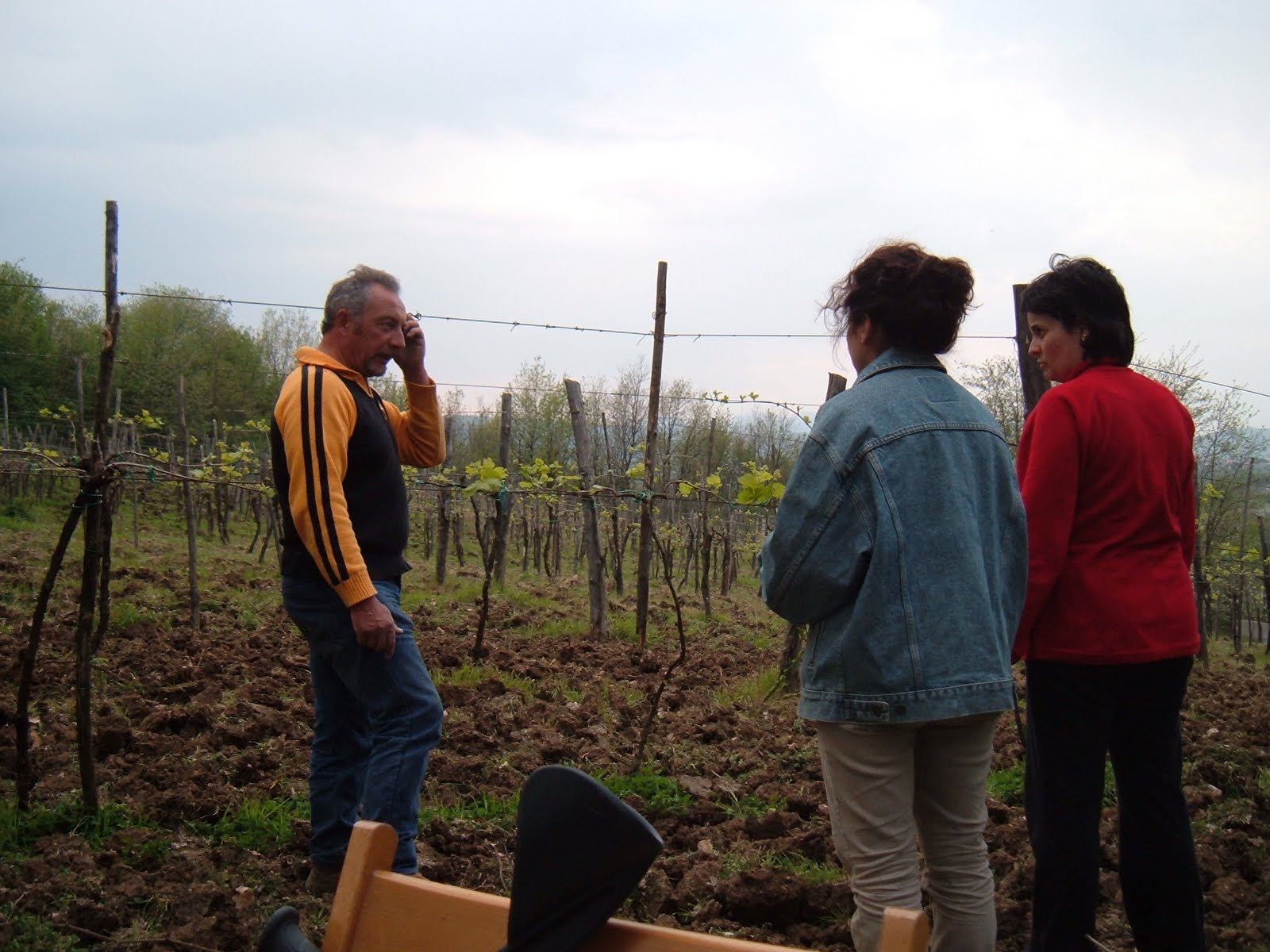
Filiberto informs me that he will be turning the soil this week so it is time for us to tie the new growth to the top wires. Before he leaves he shows me how his father used to tie the shoots to the wire. He grabs a handful of long grass and uses it like a twist tie. He says that it will last and hold the vines all summer.

As I tie I noticed that some of the grapes are starting to flower, and others show the signs of downy mildew…little grape bunches are turning brown, and I’m told they will just whither.
Sometimes this occasional withering of the bunches is another way to green prune. By reducing the number of bunches, you increase the quality of the grapes that you do harvest. That would be fine if we hadn’t already reduced our product by half. When we became owners of the vineyard, it was evident that it had had only minimum care over the past few years. The grass had grown so that it was now a vineyard on a lawn, taking valuable nutrients and water away from the vines. The vines had grown too big, and far too many shoots were allowed to remain on the vine.
The trellis system in place was two cordons of permanent spurs;
We use new cordons every year, a method called the Guyot System which uses last year’s shoots , a new fruitting cane as opposed to using the same cordon every year.


We tie all day, and we only manage to make it through 14 of the 38 rows. I don’t want to stop, but my husband and my son want to go home now. We worked through thunder and rain showers today.
On our way home we must stop off at Filiberto’s home in order to pay him for the work he does for us. Their home is newly built. The left side of the house is only a shell, and they live on the right side which in true Italian fashion is immaculate and finished in a nouveau but rustic style. His home is not on his vineyard but in the town of Solopaca. The left side of the house will be completed when one of their children marries, and they will have a ready made house for them to live in. This practice is very common in Campania as Campanians don’t like to be far from their family members, and by far, I mean across town. Next door is the ideal, shouting distance is considered acceptable. Many homes in this region either have an unfinished second story, or an unfinished duplex beside them waiting for one of their offspring to take occupancy. Many are now being sold, as it is the parents who are moving themselves to where their children have found jobs.

We arrived with a gift of a flat of strawberries, another practice that has become habitual for us when visiting someone at home. It needn’t be a big gift, but it’s a sign that shows that the relationship is more than just a transaction between two people. As tired as we were, showing up and just dropping off the money would have been an insult. Transactions in Italy are best made involving food of some kind, and the very best are those that are concluded around a table.

So paying Filiberto is not as simple as one would think. The arrangement came about during a casual conversation whereupon he realized that we didn’t own a tractor yet and so he offered his services. However, he wouldn’t tell me how much he would charge, and he looked very uncomfortable when pressed. We finally suggested a price/hour, which he agreed to, but we have no idea if we are paying him enough. He’s uncomfortable taking money from us, and we’re uncomfortable too, hoping we are not insulting him.

His sister-in-law Giovanna, his brother Michelle and his wife Pina seemed to be expecting us as they waited around his cozy kitchen table and the coffee was on. We had a cup of espresso and some “morzette”, the local name given to a biscotto, made with cacao, flour, egg whites, almonds, icing sugar and “mosto cotto”, or “boiled must” --the first free-run grape juice which is then boiled and allowed to reduce to one third to become a sort of syrup. Though I don’t have a picture of the actual biscotti from that day, this photo from the internet, pretty much resembles what we had and the recipe seems to match.
Filiberto has 3 vineyards, is a former prison guard, is a begrudging member of the Solopaca wine cooperative and urges me not to become one. He says that it will only tie me down and I will be forced to sell my grapes to them, for a lower price than I could get elsewhere. He promises me he will find a buyer for our grapes this year. I really hope so, I think to myself, wondering what I would do with all the grapes if I don’t find a buyer at the right time. I feel that he is someone I can trust. He went on to tell us about all the things he will help us do throughout the year, as well as go over all the things that need to be done in his opinion to bring the vineyard up to optimal standards. We really feel lucky to have found him.

Filiberto helps us, not because he does this for a living, as he keeps explaining to me-- he’s got enough of his own work to do-- but he says he does so because he sees our passion, and he sees how much we want to learn. When we do something that he doesn’t like, he tells us because, as he says “non vorrei che fate brutta figura.” ….he doesn’t want us to make fools of ourselves. Nor do we, so we take his advice.

Filiberto explains that he won’t be around as much to help us come September. He has a young 13 year old boy who has just been scouted by Inter-Milan, the famous soccer team, and because he is one year too young to be taken into their school and training camp, they advised his wife to take up an apartment in Milan next year. Filiberto will have to pay for this apartment and will take the little miniature train that we see from across the valley to Milan for occasional visits. His wife and their youngest son will live there. He explains that it will be a sacrifice, but what parent wouldn’t sacrifice it all to have their son set up for stardom, notoriety, and affluence, all while doing something that he and all Italians love. We all smile at this, and I wonder if the house they built next door will ever be inhabited by their children or be sold for a much grander lifestyle in Milan. Some would think that this wouldn’t be much of a sacrifice, but to see Filiberto, as attached to the land as he is, it would be, but then again, as he says, what parent doesn’t make sacrifices for their kids.

Monday, May 24, 2010

Dinner tonight.


I was really hungry when I went grocery shopping tonight, and as a result, I became inspired.

I made two appetizers...a caprese salad with fresh Mozzarella di Bufala and sweet tomatoes with a drizzle of Extra virgin olive oil, and balsamic vinegar. A little sprinkle of salt.


The next amuse-gueule was deep fried zucchini flowers stuffed with mozzarella di Bufala. I got the recipe off of the following Italian site, but I left out the anchovies:
http://www.gustissimo.it/ricette/antipasti-verdure/fiori-di-zucca-alla-mozzarella.htmstissimo.it/ricette/antipasti-verdure/fiori-di-zucca-alla-mozzarella.htm


The main course was pappardelle ai funghi from the following site:
http://www.lospicchiodaglio.it/index.php?sez=ricette&azione=scheda&elemento=323


We drank Terredora 2008 Greco di Tufo, Terre degli Angeli, DOCG. It is made with 100% Greco grapes. It was bright golden in colour, with a good consistency/viscosity in the glass testifying to its 13,5% alcohol. The aromas were intense of fresh fruit: apple,citrus, followed by spring flowers and a little bit of fresh grassiness. I could taste the same fruitiness as I took my first sip. It was smooth but well-balanced with a nice acidity and minerality that was somewhat persistent. This wine held up well against the mushrooms, and neither overpowered the other. I thought it also went well with the zucchini flowers. This is a winery that is consistently scoring in the 90's, and they are a great ambassador of Campania wines. Here is their English website:
Some of my best meals are a result of being hungry in the grocery store. My head spins with my favorite meals, and my eyes dart around for the ingredients.

Sunday, May 16, 2010

Buying a Vineyard in Solopaca, Italy.

There are many people who have made their way to Solopaca over the millennia for a variety of reasons: Archeological digs have revealed that people have inhabited the area since pre-history. The first to plant vines on its verdant slopes were the Etruscans and then the Samnites. Virgil and Horace both make mention of the wines of Solopaca back in the 1st century B.C. The Romans thought of it as an area worth preserving for its important shepherd trails.
To reach Solopaca from Napoli you must first travel along the Strada Statale 7, Via Appia, the road that was first constructed by the Romans as a strategic military route from Rome to Brindisi. Almost 2000 years later, I followed the same route and made my way to Solopaca in search of a vineyard to buy.
In December of 2009 we bought a vineyard in Solopaca. We live and work in Naples so our vineyard had to be within commuting distance of our work. Our research, our pocket book, and some divine intervention led us to Solopaca.
Our criteria were an existing vineyard, preferably with DOC grapes, small enough that my husband and I could handle on our own. We looked at well over 20 properties over a period of 8 months, hemmed and hawed over a few of them and finally settled on the 1st property we had seen.
The divine intervention came in the form of a man called Peppino Riccardi, a geometra in Solopaca. When you buy a house or a piece of property in Italy it is necessary to have a geometra who’s job is something between that of a surveyor and an architect. (For more info on what a geometra is see the following website: http://www.keyitaly.com/article/geometra-checklist/ )
He is younger than he looks, dresses like a country gentleman but with baggy pants that are somewhat too long, a blazer that is too big, over a vest. His eyes resemble Mr. Magoo’s and his office is a jumble of fading stacks of blueprints and papers that look like they’ve been sitting in the same place since the 1970’s. He’s a one-finger at a time typist, and doesn’t see the keyboard very well, and is not sure where the letters are. Watching him fill out forms can be a painful experience for an impatient person such as myself.
When I first met him, I was in the company of my agent, Maria, who couldn’t understand why it was taking us so long to decide what to buy, when we had clearly seen all that there was to see. At that point we had our heart set on a piece of land that was part vineyard and part olive grove with a stupendous view over the Caldaro valley and the hills beyond. We had been back to see it many times, invited an architect from Rome out to see it, but something prevented us from moving forward. The owners were anxious to sell and Maria, our agent, was feeling their pressure. She finally brought me to Peppino, whom she said would answer all of my questions. In his office, Maria patiently asked me to explain to Peppino my concerns with the property in question. I thought about this for a moment or two, then explained in my broken Italian that I think it might be just fear of the unknown, that it was a big step for us, that we were afraid: afraid we wouldn’t like it in a town where we would be the only foreigners; I also explained that we were afraid that maybe after a while, we would want to move back to Canada, and would we be able to sell and get a good return on our build. Peppino asked me a simple question. “What is your goal in buying this land?” I said we wanted to first concentrate on growing good grapes, and then possibly have a winery.
The agent, went on her way, and left Peppino and I to visit the property that we had in mind. As I drove I noticed that Peppino crossed himself whenever we passed by the cemetery and everytime we drove past one of the 8 churches in the small town of Solopaca.
I showed him around the property, and explained to him our grandiose plans for the property while his expression became more and more perplexed. Finally he spoke.“Senti, io sono un uomo onesto….so I must tell you something. “Yes it is a beautiful piece of land and the view is meraviglioso…but I thought you told me that you wanted to grow good grapes, and eventually make good wine. Look around you…do you see any working vineyards here? This is olive country. People don’t even live out here. The land is dry and it is best suited to olives. Now show me another property, because you will never get your money back if you build a home and a winery here.”
His words were like a big Stop sign that suddenly appeared behind a cover of fog. The fog suddenly lifted, and all became clear. He recognized our fear and confusion, and led us to what we had set out to find. We settled on the first property we had seen…way back when we were clear about what we wanted. “Cerasella” as the area of Solopaca is called where we have bought our vineyard, was in our price range, is an existing DOC vineyard, has the perfect inclination on a verdant slope of the North side of Mount Taburno, looking onto Caldaro river and valley and mountains beyond, and is the right size being just under 1 hectare or 2.5 acres. It is known for its well-exposed, well-drained land, in clay-calcareous soils. It had been there all the time, patiently waiting for us to see its beauty, its practicality, its potential.
The name Solopaca comes from its 11th century name “Surrupaca” which literally means “opaque sun”. This has been interpreted as a land with a lot of sun or paese del sole which has inevitably led to its destiny as the most intensely cultivated viticulture zone in Campania. The sign on the way into town today says, Solopaca, citta’ del vino. It is nestled along Mount Taburno and stretches 2 kilometers horizontally at about 250 meters above sea level. Today it has a population of about 4000 inhabitants.
When you buy a piece of property in a place where there is so much history and folklore, you never really own it…you borrow it for a while, you become but a page of its story: One that started long before we arrived, and one that will continue on after we leave it.
The road to Solopaca is a new route for us, but the footsteps that led us there are deeply cast in the ground and history. We just needed to look for the signs through the fog.
Wine Review:
Pampanella 2009
Masseria Vigne Vecchie
Falanghina DOC Solopaca
100% Falanghina
It is bright straw color and green around the rim. It has medium legs and the label reads 13% alcohol. The perfume is subtle with scents of fresh spring flowers, and fragrant citrus scent. It is dry with a lovely smooth finish. While it may be subtle on the nose, it offers a long minerally aftertaste, typical of Falanghina. This wine received an honorable mention at the 2009 International Biological Wine Fair promoted by Citta del Bio. As with all Falanghina’s this would be a perfect accompaniment to fish dishes, but because of its mineral aftertaste it could also stand up to white meats and medium aged cheeses.
Sources:
http://www.seguendoulisse.it/regione-campania-contenuti/?id_cat=16&id_contenuto=48&language=en&index=Seguendo-Ulisse-BENEVENTO+AND+PROVINCE-SOLOPACA
http://it.wikipedia.org/wiki/Solopaca
http://www.savourthesannio.com/blog/
http://www.sanniti.info/indexen.html
http://www.tigulliovino.it/dettaglio_articolo.php?idArticolo=969
http://www.cantinasolopaca.it/
http://en.wikipedia.org/wiki/Appian_Way

Friday, May 7, 2010

Italian Wine ….I’d Like To Get To Know You


A question that I am often asked by friends when they find out I am an Italian sommelier, is what wine should I buy to bring home with me to Canada? How long will it last? It is really difficult to figure out Italian wines from the label: Montepulciano d’Abruzzo, Bardolino, Barolo, Brachetto d’Acqui, DOCG, DOC, IGT. These are the labels that you may have come across while trying to choose your Italian wine to accompany your Sunday dinner. To North Americans, these labels don’t give us a lot of information about the wine. In North America, wines are labeled according to the type of grape. If it is a California wine, it will tell you on the label that it is made with Zinfandel, or Merlot, or Chardonnay. In Italy and France, the name on the bottle tells you the area or the town that the grapes/wine have come from.

In Italy the grape topography is somewhat more complicated than it is in France. Whereas France has chosen to limit its viticulture areas to 10, Italy has taken the approach that each of its 20 political areas has indigenous grapes that are of high quality, and are valued for the terroir in which they grow, and are perfect matches with the regional dishes of the area. While France uses just over 100 different grape varietals, I’ve heard it said that Campania alone has close to 300 varieties. How can a foreigner ever begin to grasp what is in a bottle of Italian wine and what they can expect from it?


First of all, it is helpful to understand the hierarchy of wines that exist in Italy.
Italy has created a sort of hierarchy of quality for the consumer. At the base of the Italian wine pyramid, you will find the Vini da Tavola or table wines. They are usually generic, bottom end wines price wise, but not always in quality. They have only to follow the laws set out for hygiene and they must be produced in Italy. They will not have a year on their label, nor will they indicate where the grapes come from. There are some “Vini da Tavola” that are of very good quality. These are wines that do not adhere to any dictates by the government other than health regulations and taxes related to selling wine.

The second category is the I.G.T., which stands for Indicazione Geografica Tipica. This category refers to table wines that are produced in a certain geographical area. On the label they may refer to the types of grapes used, and the year that the grapes were picked. Generally, but not always, these wines are higher end table wines. However, even here you have to know what you’re buying because there are some “I.G.T” wines that are of extremely high quality. The only reason they are labeled as I.G.T. is because they may be using grapes that are not dictated by law for that area. They may have chosen to use an International variety such as Cabernet Sauvignon. The Super Tuscans fall into this category and they demand a very high price and are revered worldwide.

The D.O.C. designation or Denominazione di Origine Controllata has stricter, more rigid rules that must be followed. It refers to a specific viticulture zone within 1 of the 20 political regions of Italy. The zones are defined by specific boundaries and have to be registered with specific authorities. Not only do the wines have to come from within the boundaries of the specific area, but the grapes used and the quantities of the grapes that are grown per hectare must be those defined for that zone. These wines have to submit samples to be tested chemically as well as have the specific aromas and qualities of the wines that they represent. There are currently over 300 DOC wines in Italy.

At the top of the pyramid are the D.O.C.G. wines where there are even more rigid and strict quality controls. The same rules apply for the D.O.C. G. as for the D.O.C. wines but in this case there are more rules to follow in the vineyard and in the winery. Thus the word “garantita” is added to the Denominazione di Origine Controllata e Garantita. As of March 2010 there are 49 D.O.C.G. wines in Italy. The following table is meant to help you with your wine choices by listing the Region, the DOCG wine name, the Grape, a short description of the type of wine, and it’s “best before date”, some of the best producers as dictated from the 2010 Duemilavini guide book to Italian wines, as well as some suggested pairings. I have not tried all of these wines, but I plan to make my way through them as I find them. The producers I have listed have the highest ratings for the wines that are listed. Most have received the maximum of 5 glasses (bicchieri) in the Duemilavini 2010 edition. Some of the wines, you may only be able to find in the area where they are made. Please contact me for a list of the websites and other contact information of the wineries that are cited here.

Where is the best place in Naples to buy wine? Enoteca’s will have knowledgeable staff, and will have on offer wines from the best producers as well as some very good values, and some new producers who are trying to make a name for themselves. The largest selection that I have found of DOCG wines can be found at Auchan. The best prices I have seen for wines are at the Save Center on the NATO base in Bagnoli.
While DOCG wines are not the only good wines to buy and taste while in Italy, they are a good place to start if you are trying to build a private stock of very good to excellent Italian wines.

Special thanks to Alfonso Cevola, in his wine blog “On the Wine Trail in Italy for his up-to-date list of ever growing DOCG wines.
http://acevola.blogspot.com/2009/12/newest-best-italian-docg-list-now-up-to.html

Some wine descriptions are my own, and for the others, I referred to the Italian descriptions in the book, Il Vino Italiano 2B, Panorama vitivinicolo attraverso le denominazioni di origine”

The Duemilavini/2010 is published yearly by Bibenda Editore and can be purchased from their site http://www.bibenda.it/

The table is here!